

Eighteen months ago, the LA Clippers did the right thing.
They pivoted from an era defined solely by superstar personalities and expectations to one buoyed by the hustle, grit, and determination of role players, highlighted by the signing of Derrick Jones Jr., bringing back Nicolas Batum as a free agent, and acquiring Kris Dunn via trade.
If the star power of Kawhi Leonard and James Harden was their skeletal structure, the impact of Jones, Dunn, Batum, Ivica Zubac, and Norman Powell was the invaluable tissue and nervous system.
The Clippers rode the wave of that core group, going 18-3 in their final 21 games to finish with a second consecutive 50-win season en route to snagging the 5-seed in an ultra-competitive Western Conference playoff landscape. The season ultimately ended with a painful 7-game first-round loss to the Denver Nuggets, but it didn’t undermine their overarching message: the sum was greater than the parts.
It was a team, after all. Everyone knew their role. And the competitive spirit was as healthy as it had been in some years, a far cry from the final days of the underwhelming and sometimes snakebitten ‘213’ era of both Leonard and Paul George, which featured ill-fitting signings that have cost the team still to this day.
But that has all eroded in the seven months since the Clippers were eliminated in the thin Denver air.

Clippers’ miserable season rolls on with another blowout loss

INGLEWOOD, Calif. -- The LA Clippers’ ongoing miserable season reached another low on Monday night as they dropped a 121-103 affair that has now placed the franchise that’s in the midst of an impressive 14-season winning streak with an inconceivable 6-20 record.

Following that loss, the Clippers opted to continue their mantra of prioritizing future cap space, namely in both the 2026 and 2027 offseasons, which would lead to them eventually trading standout guard Norman Powell to the Miami Heat in a three-team deal to acquire forward John Collins from the Utah Jazz.
In theory, the trade made decent basketball sense.
The Clippers have long sought to find more size on the front line as they look to feature Leonard more at small forward, even though there is a belief that Leonard’s best position at this stage of his career is as more of a power forward when deployed as a help defender who can blow up the defensive actions of opponents without having to do too much work on the ball.
That’s where the value of both Dunn and Jones came to the forefront. Those two were still part of the roster going into this season, and at least one of them was going to remain in the starting lineup alongside Harden, Leonard, and Zubac to help ease some of the defensive burden.
The trade for Collins was supposed to fortify the front line for the Clippers. Collins had come off a season where he averaged 19 points and 8.2 rebounds in 30.5 minutes for a Jazz team that finished with the worst record in the league. The forward shot nearly 40% on 3s last season and 38% over the prior two, giving the Clippers some confidence that, in a scaled-down role from his Utah run, Collins’ efficiency could even jump due to having both Harden and Leonard take defensive eyeballs away from him.
Unfortunately for the Clippers, that hasn’t come to fruition.
Collins is averaging 12 points per game, his lowest since his rookie year. He’s averaging a career-worst 4.5 rebounds and 0.7 assists. To make matters worse, the forward has made just 29% of his 3-point attempts and is converting a career low 49.6% of his shots. In total, it’s been a disaster.
In a bit of a surprise to some, Collins began the season coming off the bench for the Clippers as head coach Tyronn Lue attempted to keep cohesiveness with a starting unit that featured Harden, Leonard, Zubac, and Jones, a quartet that yielded plenty of positive minutes and results for the Clippers a few months earlier.
The thought behind it was to keep Jones, a defensive-minded wing, on the floor alongside Leonard and Zubac to maintain the identity they had forged on the defensive side of the ball the previous season. But after Bradley Beal’s injury, Lue needed more offensive punch with the starting group, and, naturally, it led to Collins’ inclusion.
Being added to the starting lineup, which happened on Nov. 10, hasn’t helped matters; it’s only exacerbated the issue. Collins is averaging 11.3 points and 4.4 rebounds as a starter, making 46% of his total shots and going 12-for-54 (22.2%) on 3s.
Per Cleaning The Glass, lineups featuring the quartet of Collins, Harden, Leonard, and Zubac are only outscoring opponents by 3.2 points per 100 possessions when excluding garbage time. Last year, lineups with Powell, Harden, Leonard, and Zubac outscored opponents by 15.4 points per 100 possessions.
None of this is purely Collins’ fault. Everyone is to blame for what’s gone wrong.
But it’s clear that the Clippers have missed what Powell brought to the table as a second-side creator and quick-twitch offensive weapon. The guard is averaging a career-high 24.4 points for the Miami Heat, converting 42.9% of his 3-point tries.
The reason behind the Clippers’ trading Powell is a simple one: they wanted to keep the books clean for those upcoming summers, and a lucrative, long-term extension for Powell, which is what he was seeking, according to league sources, would have eaten into the Clippers’ available cap space.
The player that the Clippers signed to replace Powell in the starting lineup, guard Bradley Beal, never got off the ground this year. Beal only played in six games before enduring a fractured left hip that ended his season. He only managed 8.2 points per game.
Beal was supposed to supply some of what Powell could, with Collins filling in a bit of the rest. It was viewed as a two-for-one type swap. Instead, it became none-for-one.
The Clippers have also been impacted by injuries in a way that has neutered their ability to field the team they thought they’d have, even going beyond Beal’s fractured hip.
In the last-second loss to Miami on Nov. 3, forward Kawhi Leonard rolled his ankle and foot on a defensive possession. It would cause him to miss the team’s next 10 contests. They went 2-8, needing a franchise-record 55 points from James Harden to beat the Charlotte Hornets and a 41-point triple-double from Harden in double overtime to knock off the Dallas Mavericks.
But things haven’t improved since Leonard’s return, as the team has managed a disastrous 1-9 record in the 10 games since his reintroduction. Leonard himself has put up great surface numbers, averaging 25 points on a 60.3 TS%, but it hasn’t led to much winning. The points are the most Leonard has scored since his first year with the Clippers, when he finished fifth in MVP voting.
There won’t be any sort of high MVP finish this season, that’s for certain. Not with the team mired in a 6-20 start.
The injuries have forced a heavier burden onto the shoulders of James Harden, who is averaging 26 points, 8.1 assists, and 5.2 rebounds on a 62.4 TS% this season. Harden is posting his highest Usage Rate since 2019-20. The guard was a game-time decision due to a left calf contusion ahead of Monday’s loss. But Harden would eventually play, ending with 13 points in 31 minutes.
Five days after Leonard rolled his ankle against Miami, Beal fractured his hip. Eight days after Beal’s bad luck, forward Derrick Jones Jr. endured a significant knee injury when Boston wing Jaylen Brown dove for a loose ball and collided with Jones. Four days after Jones got hurt, guard Bogdan Bogdanović also endured hip troubles.
It all led the Clippers to being forced into starting rookie second-round pick Kobe Sanders for a three-game stretch.
And it’s meant that the projected starting lineup out of training camp -- Harden, Beal, Jones, Leonard, and Zubac -- will have played just 63 minutes together this season.

Clippers, Chris Paul part ways amidst disappointing season

It was supposed to be a sentimental send-off.

Training camp was also the stage for what would ultimately end up being the season’s greatest folly.
The injuries take a toll physically and can be attributed to a bit of bad luck. But the day-to-day mental anguish that has blanketed the team since signing 40-year-old franchise icon Chris Paul this past summer was wholly self-inflicted, and everyone is to blame for what transpired.
Paul wanted to come back and finish his career in Los Angeles. It was known to everyone within the organization how desperate Paul was in angling for the reunion to happen, and as such, there were a multitude of conversations with Paul in the weeks leading up to his signing in late July as to what his role with the team would be.
The Clippers were not looking for Paul’s contributions on the court, even going so far as to have president Lawrence Frank, in the press release when they signed the guard, say Paul was “joining us as a reserve point guard and is excited to fill whatever role T Lue asks him to play.”
They didn’t expect much out of Paul, even coming off a season where he started all 82 games for a San Antonio Spurs team that wasn’t yearning to bring the guard back, league sources have told Russo Writes.
Instead, the Clippers were hoping Paul would be a worthwhile addition to the team in a locker room capacity and as a mentor to the team’s younger players, which he was seen doing on a few occasions in the locker room after games when he’d huddle with those young players he sat near.
Because Beal wasn’t able to be a full participant for the majority of training camp, ultimately not debuting with the team until their preseason finale against the Golden State Warriors, it led to Paul being thrust into the second-unit lead guard role as others filled the role vacated by Beal at the time.
Paul and the second unit, which also featured Collins and newcomer Brook Lopez, would get the better of the starters on a few occasions, sources confirmed to Russo Writes. That only empowered Paul to become the thing that the Clippers were afraid of: an outwardly vocal nuisance.
The growing animosity between Paul and the coaching staff, namely lead assistant Jeff Van Gundy, has been well-documented and reported on, and that tension led to a rift between Paul and head coach Tyronn Lue before Paul was sent home following the team’s Dec. 1 road game in Miami.
It stands to reason that the Clippers knew the PR hit they would endure by sending Paul home, and the basketball world has been sure to let them hear it at every turn.
But, for the Clippers, it was something that had to be done, no matter the cost in the public eye. Behind the scenes, ripping the Paul band-aid off helped emotionally and mentally, even if the record since his dismissal, a 1-4 mark, hasn’t done anything to make headway in their dismal season.
The Clippers knew the potential downfalls of signing Paul and did it anyway, which is on them. Beyond the off-court issues, the on-court service Paul provided wasn’t worth the headaches elsewhere.
Paul’s second stint with the Clippers ended with him averaging 2.9 points and 3.3 assists on 32.1% shooting. The future Hall of Famer posted the worst shooting efficiency, turnover rate, and assist rate of his career.
Every move the Clippers made this past offseason has failed, even attempting to fill the years-long backup center void by signing veteran Brook Lopez.
The 37-year-old big man has been hindered by a changing NBA, unable to move as fluidly as he once could and has looked out of place when on the floor. For the first time in his career, Lopez is strictly a backup. The center is averaging a career low 5.8 points and is shooting just 39% from the field.
According to a source not authorized to speak publicly, Lopez would be better suited in the starting lineup since most teams employ a large starting center for him to tangle with. But on bench units, which, outside of a few teams, have scaled down in size in recent years, Lopez looks like a relic of basketball’s past. The issue for Lopez is that a starting position isn’t available on the Clippers due to Ivica Zubac’s presence, and there’s no reason for the team to uproot Zubac in favor of Lopez.
Lopez was benched for a six-game stretch as the team looked into other backup center options, such as John Collins and Nicolas Batum, as well as third-year forward Kobe Brown. Lopez would return to the lineup for a two-game spell that featured matchups against Rudy Gobert and Steven Adams before not playing on Monday night.
An offseason after seemingly hitting every right button, the Clippers pressed every wrong one, and it’s led them to where they’re at.
They played on sentimentality and seniority rather than form and function, and the end product is what you see today -- a team floundering at the bottom of the standings without a first-round pick to show for it.
That pick is gone. It can’t be brought back, and it, in conjunction with everything else they sent out the door, was a high price to pay for an era that lasted a few bright years.
The Clippers will see their streak of 14 consecutive winning seasons end, and no matter how you thought this season could go after the moves made this past offseason, it never felt like that streak would end now. Not after last season.
The franchise looks up to organizations like the Miami Heat, who thrive on stability and a front office that works in unwavering partnership with their head coach. But even the Heat have had some down seasons. However, they’ve also made two Finals in the prior six years.
Whether or not the Clippers can achieve that level of success remains to be seen. Yet, it signals that grandiose overreactions aren’t something they’re looking for. Instead, they’re honed in on a measured approach, even amidst the turbulent nature of this present season.
Perhaps, in the long run, this season will be for the best for the Clippers. It’ll give them a real chance to examine what went wrong and adjust accordingly, even beyond the injuries.
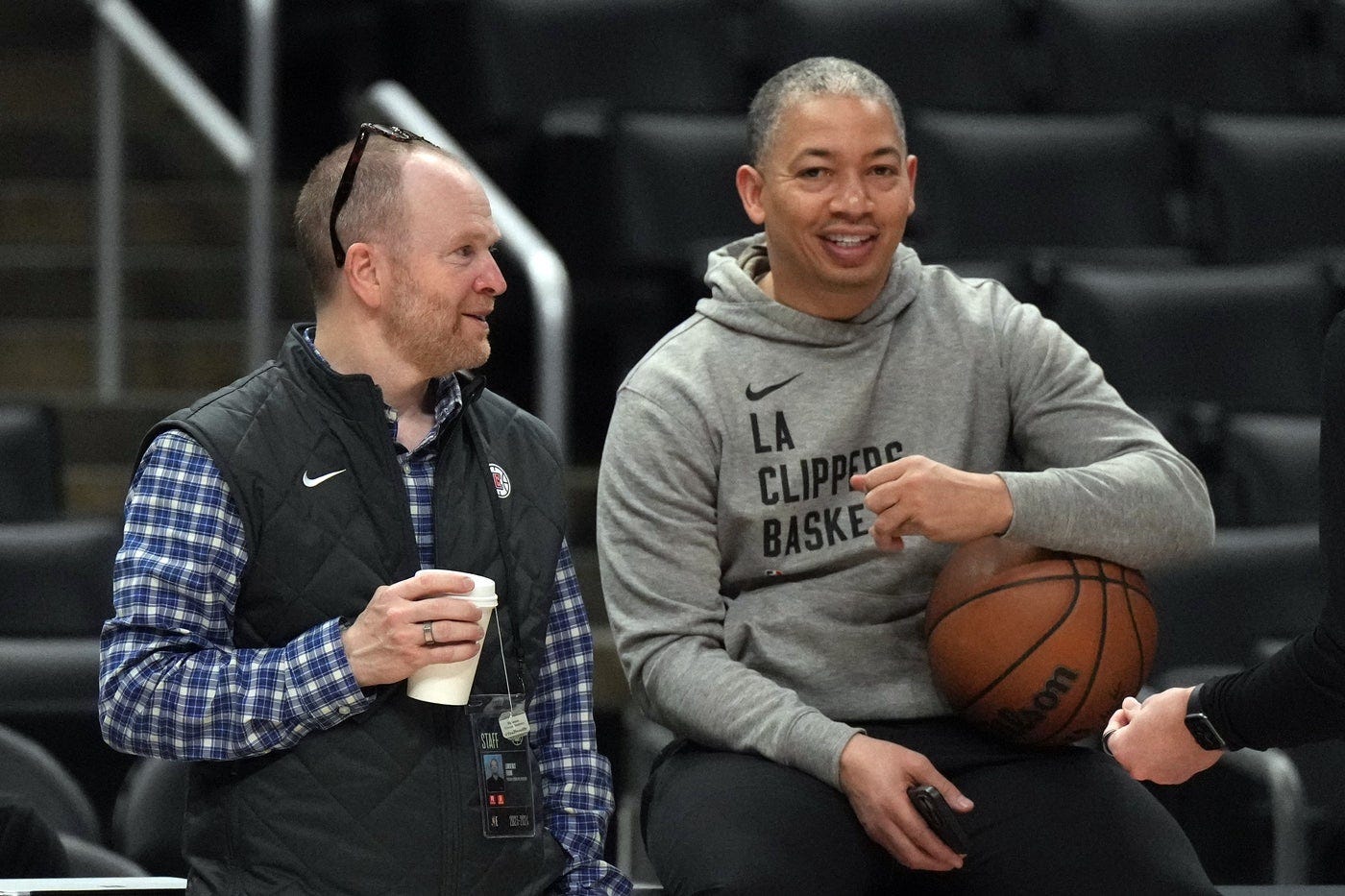
On Monday, before their blowout loss to the Memphis Grizzlies, Clippers president Lawrence Frank met with season ticket members in the arena’s Court B area. Roughly 100 fans were seated on chairs in a semi-circle underneath one of the baskets, aligned three rows deep. Frank walked in and sat in the middle of them, allowing for an intimate setting where fans could voice their issues directly with the team’s top decision maker.
An hour later, the meeting ended. In between, concerns were voiced and discussions took place. Frank shook hands and took pictures with fans who approached him after the event concluded, talking with them and hearing their pleas.
The Clippers know they have to get this next stage right. They can’t afford for it to go as haywire as this year has. They need to strike gold as they did 18 months ago.
If not, there might not be many fans left to hold a meeting with.

As always, a well written and informative article. Sad to see a promising season go as disastrous as it has this year. I'm hindsight, should have known the risk of depending on an old roster with a long injury history, but could not imagine it would be this bad with no silver lining in sight.